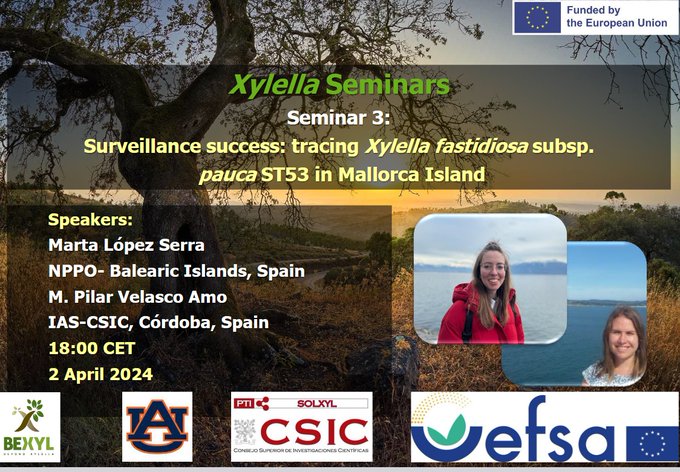
On April 2, 2024, a seminar organized by the Spanish National Research Council (CSIC) was held under the title “Surveillance success: tracing Xylella fastidiosa subsp. pauca ST53 in Mallorca Island.” This seminar was part of a series of activities focused on research into and management of the bacterium Xylella fastidiosa and was made available through CSIC’s science outreach channel “Solutions to Xylella fastidiosa.”
The session featured Marta López Serra (NPPO Balearic Islands, Spain) and María Pilar Velasco (Institute for Sustainable Agriculture, IAS-CSIC, Córdoba, Spain) as the main speakers. The seminar addressed the success and lessons learned in the epidemiological surveillance of Xylella fastidiosa subspecies pauca, sequence type ST53, on the island of Mallorca—one of the European areas where this subspecies has been detected and is currently under monitoring and analysis.
During the presentation, methodological aspects and results related to the detection, tracing, and assessment of the presence of this subspecies in Mallorcan territory were reviewed, as well as the role of surveillance and monitoring strategies in the early management of outbreaks. The seminar also had a training component, placing the phytosanitary situation regarding this emerging pathogen in the Balearic Islands into context.
The pauca ST53 subspecies of Xylella fastidiosa is particularly relevant due to its association with Olive Quick Decline Syndrome in other affected areas of Europe. Its detection in Mallorca has required coordinated phytosanitary surveillance and technical response efforts to assess its extent, potential impact, and appropriate response measures.
The seminar forms part of the ongoing activities of CSIC and associated research groups aimed at promoting the exchange of scientific knowledge on the biology, epidemiology, and management of Xylella fastidiosa, as well as strengthening the training of technicians, researchers, and managers in tracing and control methods for this pathogen.