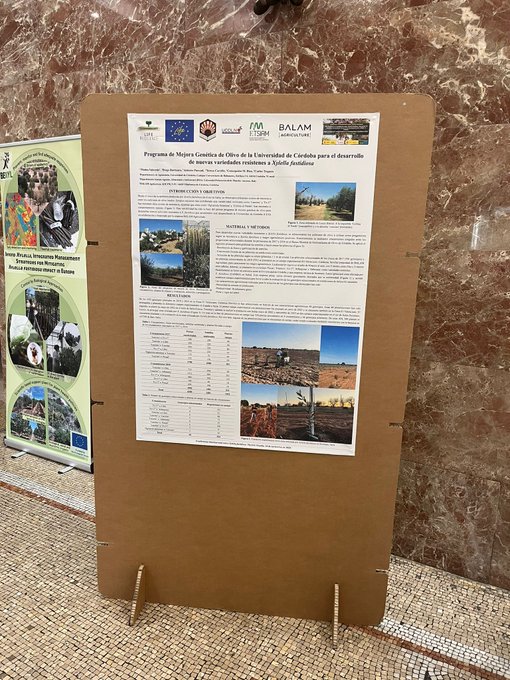
On November 14, the International Conference on Xylella fastidiosa took place in Madrid. This high-level scientific meeting was organized by the Spanish National Research Council (CSIC) and the Ministry of Agriculture, Fisheries and Food (MAPA). The main objective of the event was to analyze the most recent scientific advances in the study, prevention, and management of this phytopathogenic bacterium, considered one of the major threats to strategic crops in the Mediterranean region, especially olive and almond trees.
Within the framework of this conference, the University of Córdoba presented a scientific poster showcasing results obtained as part of the European LIFE Resilience project. Although no press release or external publication describing the specific content of the poster in detail has been identified, its presentation forms part of the project’s scientific contributions to knowledge on Xylella fastidiosa.
The LIFE Resilience project, co-funded by the European Union’s LIFE programme, aims to develop and validate sustainable strategies to increase the resilience of agricultural systems to Xylella fastidiosa. Its main lines of work include the selection and evaluation of olive varieties and genotypes with greater tolerance, the application of sustainable agronomic practices, vector management, and the enhancement of biodiversity as a preventive tool.
The participation of the University of Córdoba in this international conference, through the presentation of the poster, represents an action for the scientific dissemination of the results of the LIFE Resilience project to a specialized audience composed of researchers, technicians, and agricultural and plant-health managers, reinforcing the project’s role within the context of European research on Xylella fastidiosa.